
Tullie has been at the heart of Carlisle’s cultural life since the 1890s and has long been celebrated for the quality of its exhibitions. And now, thanks to the latest phase of the £15-million Project Tullie redevelopment, visitors are welcomed into a large, light-filled space with a ‘wow’ factor designed to reflect that quality.
The response has been very positive, says Amy Walker who, as Tullie’s head of strategy and capital, is leading every phase of Project Tullie. ‘People say they could be in a London or international gallery.’
Having passed beneath Tullie’s renovated Gatehouse on Castle Street, visitors enter at a big mauve T – some like it, others don’t – into a stylish new atrium, where Serena Korda’s ceramic installation, Hold Fast, Stand Sure, I Scream a Revolution, hangs from the ceiling.

An electricity sub-station has been removed to make way for a vibrant new shop, and the new Carlisle Gallery serves as a taster for the rest of the museum. Beyond the Carlisle Gallery is Tullie’s prestigious art gallery and, on the first floor, the new City Hall Studio offers theatre and boardroom space.
Shortly before the new spaces opened in April 2025, the museum’s reimagined Café Tullie was unveiled, its original parquet flooring restored and works by artists including the 2002 Turner Prize winner, Ulverston-born Keith Tyson, on its walls.
The museum and art gallery’s buildings are Grade I listed, ‘but work was required to connect them and make them more accessible,’ says Amy.
‘Tullie is landlocked, with big walls around us. People could feel “it’s not for me”, that there were physical barriers to walking through the door. We wanted to resolve that and better reflect who we are and what we do, through having more collections on display and fewer intimidating spaces.’

‘Central to Tullie’s vision is its origins as a library, museum and school of art,’ says Amy. ‘We are looking at what these elements mean to the community, and our role in bringing that knowledge, resourcefulness and creativity into the heart of the city.’
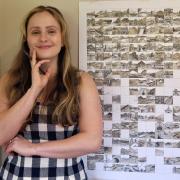
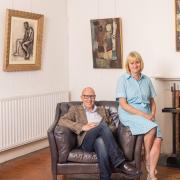
Amy, 46, who lives in Carlisle, is in the senior leadership team headed by director Andrew Mackay.
She jokes that she has probably had a different job title every year since she joined Tullie as a gallery assistant with a zero-hours contract in 2004.
Her progression at the museum, which was known as Tullie House until 2024, has been inspired by a love of the arts which began in childhood. Born in St Alban’s in Herts, Amy moved to Caldbeck with her parents Annie and Peter and sister Grace when she was five.
‘Our family has always engaged with the arts, with music and theatre,’ says Amy. ‘It’s our way of having fun.’

Her father was in a band, and her mother went to gigs across the UK. ‘Mum would take me to Stanwix Arts Theatre in Carlisle, where her friends were performing.
‘She took me to see Michael Jackson in Wembley in 1992, and we ended up at pitch-level dancing round.’
Amy had started drawing at an early age, and her love of design and making soon encompassed interior and furniture design, and upcycling. After gaining A-Levels in geography, art, and design and technology at Caldew School in Dalston, she studied Design Crafts at Cumbria Institute of the Arts in Carlisle (now the University of Cumbria) and graduated in 2001.
Organising an event to sell artwork as part of her course, Amy had realised that taking culture into the community was as enjoyable as the creative side.

But she had no clear idea where her career path lay and was working three casual jobs when she was accepted at Tullie. ‘I loved it immediately. It felt very special to be there.’
As a gallery assistant, Amy put herself forward for exhibition installations, learning the ropes from Tullie’s curators and from national museum couriers. Next came a secondment to Carlisle City Council, which ran Tullie until it became an independent charitable trust in 2011.
After 16 months in the council’s business events tourism unit, Amy returned to Tullie for an admin job in the council’s arts unit, helping set up exhibitions and run major events such as the folk and roots festival Brampton Live.
She went on to produce and create exhibitions, advancing from exhibitions and events assistant to manager, programming manager, head of programmes and projects, and head of programme and development.
Having helped her then boss Mick North set up the Monday Alternative movie evenings at Tullie, Amy later secured British Film Institute funding for a festival. In 2014, she was presented with the Carlisle Living Culture City Award for delivering high profile exhibitions and innovative late night museum events. She developed relationships with national institutions and brought local businesses on board for city centre events, one of them linked, for example, with a street art exhibition at Tullie.
‘We are always very grateful when other businesses want to partner with Tullie. To make Carlisle great, we must work together.’
One of the biggest and best projects, says Amy, was the 2015 exhibition of works by German painter and sculptor Anselm Kiefer, whose themes include the horrors of the Holocaust.
The exhibition was staged with Artist Rooms, a programme and collection managed by Tate and National Galleries of Scotland.

Amy took on a curatorial role alongside Tullie’s keeper of fine and decorative arts, Melanie Gardner, and an external curator.
She also ran a Museum Late event and a project with the University of Cumbria.
‘For me it was a perfect fusion of project management, creativity, design, curation and events,’ says Amy.
One of her most ambitious projects involved visiting 10 cities in China in 11 days to develop the partnership which led to Tullie’s Covid-disrupted Treasures of China exhibition in 2020. But for the past few years, Amy’s primary focus has been Project Tullie. When Andrew Mackay became director in 2016, he aimed to build audiences and income and make Tullie more sustainable as a charity.
Its Future Plan – now Project Tullie – with 15 phases and a timescale of 10 to 15 years, was launched in 2019 and the first phase, the Costume Gallery, opened in 2021.
Phase two was the work completed in 2025 and the next phase, says Amy, will chime strongly with the museum’s mission to transform Tullie into the ‘creative and cultural heart of the Borderlands’ through its focus on people, place and heritage.
‘We are going to get 100,000 objects out of storage and put them on display.
‘This will free up the original museum space, bringing it into public use later.’
Despite living and breathing Tullie, Amy finds time for seeing family, fell walking, travel and gigs including, recently, Taylor Swift, Kylie, Haim, and Self Esteem.
Last July, at a graduation ceremony in Carlisle Cathedral, Amy became University of Cumbria Alumnus 2025.
‘Andrew nominated me,’ says Amy. ‘I’m lucky to have a very supportive boss.
‘It was all very grand, quite the big fuss. My sister joked it was my coronation.’
In her response to her award citation, Amy paid tribute to the support she has received from Tullie’s staff and trustees. ‘I’ve had a fantastic time putting on festivals and events, alongside the joy of designing exhibition layouts and campaigns for Tullie. Now I make the built environments so that people can thrive and create within them.’
tullie.org.uk