


It was the acid test for any would-be volunteer warden in the newly-created Peak District National Park in the early 1950s.
They had to see if they could keep up with the long-striding Tom Tomlinson, the first-ever full-time warden in the first-ever British National Park, as he ascended The Nab, a southern promontory of Kinder Scout, the reigning, 2,088ft summit of the National Park.
And as John Pemberton, a long-time friend, explained in his 1997 biography of Tomlinson, Tom was ‘a big man and walked fast, taking enormous strides.’
If the prospective warden had kept up with him and has enough breath left to hold a conversation with Tom at the top, the chances are they’d be taken on.
One of those prospective wardens was 15-year-old Gordon Miller, who had heard a talk given by Tom at his Stockport school. Gordon, who later became a long-serving, full-time area ranger, recalled: ‘I was too young at the time but they let me join as a cadet.’

He vividly remembered the ‘gruelling’ test climb up to the edge of Kinder. ‘Tom walked at a deceivingly leisurely gait but with enormous strides. You had to be really fit to keep up with him,’ he remembered.
‘If you were still struggling up the slope he would ask you to come back and try again when you had become fit.’
The Peak District Warden Service, the first in Britain (they didn’t take on the more internationally-recognised name of rangers until 1974), was inaugurated outside The Old Nag’s Head pub in Edale on a typically blustery Easter Good Friday in 1954.

The chairman of Derbyshire County Council, Alderman Charles White, unceremoniously stood on a beer crate to perform the ceremony in front of a large group of ramblers, who included Bert Ward of the Clarion Ramblers from Sheffield.
The newly-formed warden service took on the vital job of patrolling the 76 square miles of moorland access land which was subject to access agreements with the landowners in the National Park.
One of the first tasks facing the National Park Authority when it was designated in April, 1951 was to sort out the thorny problem of public access to the highest moorland of the Peak, including Kinder Scout and Bleaklow.
These had been the scene of the infamous access battles of the 1930s, which culminated in the iconic Mass Trespass on Kinder Scout in 1932 which led to the scandalous imprisonment of five ‘ramblers from Manchester way’.
Tom had actually taken part in the Mass Trespass as a 24-year-old keen rambler.
So, one of the major provisions of the access agreements which the National Park negotiated with landowners was the provision of a warden service to patrol the newly-opened moors, to ensure the great unwashed British public did not chase sheep, drop litter, or start fires.

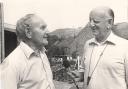
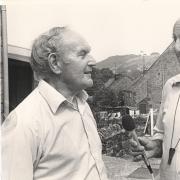
At the time, Tom Tomlinson and his wife Hilda had been joint wardens of the 120-bed Edale Youth Hostel at Rowland Cote for 10 years, and he had become well known as an expert guide and interpreter. So, when the post was advertised in 1956, Tom successfully applied for the post of chief warden of the Peak District National Park.
Tom was born in the small Lancashire mill town of Rossendale in February, 1908. He was the eldest of four siblings, one girl and three boys, and his rather taciturn father worked in a factory which made slippers.
At the age of five, Tom started at the local board school, where he joined a class of 50 pupils. Recalling his short school career later, he admitted that he was ‘hopeless at maths’ but enjoyed reading, starting with Dickens at about the age of ten.
Tom started working part-time at his father’s slipper factory at the age of 12 and when he left school at the age of 14, he joined his father at the factory, working a ten-hour day for 10 shillings (50p) a week.
This extra income was urgently needed for the fast-growing family, and he gave all his wages to his mother, who handed him back one shilling (5p) for spending money, which he largely spent on books.
It was when he was working at the slipper factory that Tom became politically aware, joining a trade union and the newly-formed Independent Labour Party.
Discovering his gift for public speaking, Tom was later selected as a prospective Labour Party candidate for the Rossendale constituency, only to be defeated by a more experienced candidate.

Tom’s father encouraged him to attend evening classes run by the Workers’ Educational Association, where he learnt French and Spanish, hoping this knowledge would help him escape from the drudgery of factory work.
It must have worked, because when he was 16 he obtained a job working for a Manchester firm which imported raw hides for leather working, acting as its correspondent with customers in France and Spain. He later travelled to both countries to inspect hides for importing back to Manchester.
When he was 18, young Tom read a book which had a profound influence on him. God in the Slums by Baptist minister Hugh Redwood so inspired Tom that he gave up his job with the Manchester hide firm and joined Redwood in his ministry in the East End of London, where he stayed for two years, appalled by the poverty he witnessed.
Returning home, Tom trained as a Baptist minister at Rawden College in Leeds, where he studied Latin, Greek and Hebrew, in addition to picking up an encyclopaedic knowledge of the Bible.
In due course he was ordained as a Baptist minister and was appointed to a Baptist church in Rossendale.
At this time, Tom was also a keen footballer and he signed as an amateur for his local club, Burnley FC, at Turf Moor, explaining that his faith would not allow him to play or practice on a Sunday.
As an amateur, he was only entitled to receive travelling expenses, but the manager promised him ten shillings (50p) every time he scored a goal. ‘I never missed one after that,’ joked Tom.

He married Hilda, a school teacher, in 1939, and as a committed pacifist, Tom refused to join up when the Second World War broke out, serving instead as a farm labourer for five years. Tom and Hilda came to Edale Youth Hostel in 1946.
It was while he was still a warden that Tom became interested in local government, becoming clerk to Hathersage Parish Council and later Outseats Parish Council, positions he held for more than 20 years.
He also became interested in local history, co-founding the Hathersage Historical Society and writing around 50 booklets and leaflets about the local area.
In his later years, Tom worked for the Sheffield Education Office and Mayfield Valley School as well as Nottinghamshire County Council at its St Michael’s Church, Hathersage, Environmental Education Centre, enthusing generations of children with his love and knowledge of the local countryside.
Tom was registered blind in 1988 and lost his wife Hilda in 1993. He died two years later at the Moorland House, the Methodist residential home in Hathersage.
At his funeral service, Coun. Fred Riddell spoke for many when he described Tom as ‘a born story teller’ who inspired thousands to love and care for the countryside.


















Share