


In ancient cultures, midsummer was a time of celebration and abundance. Crops were growing, livestock thrived and communities gathered to honour daylight, warmth and fertility. Fires were lit on hilltops, rituals performed and the sun was welcomed at its peak strength. Though the meanings may have shifted over time, our instinct to pause and look skyward remains – and Dorset’s ridges, coastlines and ancient earthworks offer some of the finest vantage points to experience it.

TOUT QUARRY, PORTLAND
For Sunset: 21.26
Solstice light: The sunset aligns with Chesil Beach as it fades into the horizon. The evening colours pick out the contrasting landscape of the wild ocean to the golden pebble bank and the still waters of the Fleet Lagoon, to the lush green hills of Dorset beyond.
History: A former working quarry turned sculpture park, tumbled stone now sits alongside carved artworks, designed to surprise, invite reflection and frame the sky. The merging of industry, art and geology creates a distinctly modern solstice setting, while still forming part of the wider Jurassic Coastline.
Access: Car park nearby, with easy paths leading through the quarry.

STUDLAND
For Sunrise: 04.54
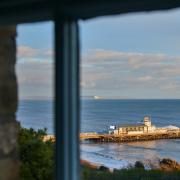
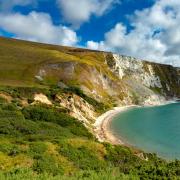
Solstice light: The sun rises cleanly from the sea, lifting above the skyline of Bournemouth, while in its wake Old Harry Rocks (pictured) and the Needles of the Isle of Wight bathe in early morning colour.
History: Studland’s sweeping bay has long been a place of passage, from prehistoric occupation to wartime training grounds. Formed by the constant movement of sand, it creates a unique natural gateway into Poole Harbour, which has led to a landscape shaped as much by the sea as by time. Today, it remains both a popular, yet surprisingly peaceful, coastal retreat.
Access: Multiple National Trust car parks provide easy access, with short walks down to the beach.

KNOWLTON
For Sunrise: 04.53 and Sunset: 21.26
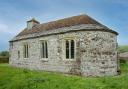
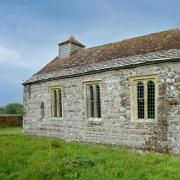
Solstice light: Sunrise breaks gently over Cranborne Chase, its path marked by yew trees often decorated with ribbons in remembrance of the dead. At sunset, light settles across the valley, with the earthworks of the church’s lost village casting long shadows across the landscape.
History: Set within a vast ritual landscape, Knowlton is a rare fusion of sacred traditions, where the earthworks of a Neolithic henge are occupied by a later medieval church. The ruinous building, once home to the best sounding bells in the county, now sits quietly in farmland, its neighbouring village long gone. Its alignment and presence suggest deep ceremonial importance spanning thousands of years.
Access: A small layby provides parking for a few cars. Owned by English Heritage, the site is free to enter and, aside from the ramparts, the ground is generally flat and accessible.

BADBURY RINGS
For Sunrise: 04.54 and Sunset: 21.26
Solstice light: Sunrise climbs from the valley of the River Allen, gradually revealing the Roman roads that cut across the surrounding landscape. At sunset, dappled light filters through the trunks of the beech avenue before sinking towards the town of Blandford.
History: This Iron Age hillfort, later used by the Romans and Saxons, is rich in both history and folklore. It is linked to the Celtic war goddess Badb, said to appear as a raven in the skies above. King Arthur is also believed to have fought a battle here and local legend claims that where blood was spilt into the soil, a golden coffin lies hidden beneath. Layers of myth and recorded history combine, giving the site a powerful and haunting presence.
Access: Owned and managed by the National Trust, a car park is on site, with easy paths leading onto the rings.

SHAFTESBURY
For Sunset: 21.27
Solstice light: Sunset stretches over the medieval hunting grounds of Gillingham Forest, with layers of distant hills and valleys of the Blackmore Vale fading into the evening light.
History: One of Dorset’s most historic hilltop towns, Shaftesbury has long been a place of pilgrimage and gathering. Its elevated position began as a hill fort, later hosting a castle and an important nunnery founded by King Alfred. Royals and nobles used the heights as a vantage point, watching the surrounding landscape before setting off on their many hunts.
Access: Town parking in the centre provides easy access to the viewpoint at Castle Green.

BULBARROW AND RAWLSBURY CAMP
For Sunrise: 04.55 and Sunset: 21.27
Solstice light: From one of Dorset’s highest hills, sunrise and sunset stretch across vast distances. Looking over the Blackmore Vale, silhouettes of King Alfred’s Tower in the east and Glastonbury Tor in the west can be seen on a clear day.
History: Bulbarrow is home to both Rawlsbury Camp (an Iron Age hill fort) and a number of Bronze Age barrows, while its ridge is crossed by the ancient Wessex Ridgeway. Its summit has long served as a lookout, beacon site and place of gathering. On its slopes stands one of the oldest trees in the county – the Bulbarrow Yew, believed to be more than 3,000 years old, witnessing the passage of the sun through countless cycles.
Access: Small roadside laybys allow direct access, with short walks leading to multiple viewpoints along the ridge and hillfort.

EGGARDON
For Sunset: 21.28
Solstice light: The sun slowly falls into the Marshwood Vale, casting long shadows across the hillfort’s vast interior, while to the south the sea absorbs the evening colours.
History: One of the largest hillforts in Dorset, Eggardon commands wide views over a landscape dense with prehistoric sites, suggesting both defensive and ceremonial roles. Its ramparts drop steeply into the vale below, while its eastern edge is connected to the surrounding landscape by a Roman road.
Access: A layby offers parking at the top of the ramparts, with a short walk on to National Trust land.

HILFIELD HILL, BATCOMBE
For Sunset: 21.27
Solstice light: A more intimate setting, where the Sun sinks behind wooded valley slopes, filtering through trees rather than dominating the horizon. The interplay of light and shadow creates a contemplative atmosphere, perfect for a quieter solstice experience.
History: Hilfield offers a sheltered, reflective perspective. The surrounding farmland and woodland create a sense of enclosure, overlooking the ancient hunting grounds of the Vale of the White Hart. Below lies the modern home of the Friary of St Francis, adding a layer of spirituality to the landscape.
Access: A small car park provides easy access, though the entrance has tight restrictions. To see the trees at their thinnest, drop down to a lower track, or enjoy the view from the hilltop plateau. Continuing along the road on the ridgeway, the trees drop away to reveal the open expanse of the Blackmore Vale below.

LAMBERT’S CASTLE
For Sunrise: 04.57
Solstice light: The sun rises over the wooded Marshwood Vale, with its patchwork of small fields, narrow lanes and rolling hills, gradually illuminating the surrounding hill forts.
History: Lambert’s Castle is one of several fortifications that once encircled and protected the Marshwood Vale. Pilsdon Pen and Lewesdon Hill rise in the distance, while the neighbouring Coney’s Castle blocks the view to the southern coast. In the 18th century, Lambert’s Castle was adapted for ornamental use, with a fairground and a horse racetrack, though today only the historic paths and grazing livestock remain.
Access: A National Trust car park sits on the western edge, with a gentle walk across the plateau to the summit.

EAST HILL, CORFE CASTLE
For Sunrise: 04.55 and Sunset: 21.24
Solstice light: From the peak of East Hill, the first light of sunrise breaks over Poole Harbour and the sandy shoreline of its bay. At sunset, the light falls across the heathland of the Purbeck landscape, with the broken towers of Corfe Castle still guarding the narrow passageway between the hills.
History: Corfe Castle was built by William the Conqueror in the 11th century and later became a Royalist stronghold during the English Civil War. The surrounding Purbeck landscape has long been a natural gateway between coast and inland Dorset, while the surrounding peaks are rich with ancient, spiritual burial mounds left by people who believed this landscape was sacred.
Access: Parking available in Corfe Castle village, with a short but steady walk up to East Hill. Open access land provides wide views, though paths can be uneven underfoot..

MEET TESS OF THE VALE
Dorset-bred Catherine Speakman, better known as Tess of the Vale, is a landscape archaeologist and cartographer who brings Dorset’s countryside to life through her website, tessofthevale.com. Blending expert knowledge with evocative storytelling, she uncovers the hidden histories and secret corners of the county through self-guided walks, rides, and local tales.
A new adventure is published each week, and her free Walk of the Month invites everyone to explore. June’s takes readers into Blackmanston, passing ancient stones to unravel a real-life tragedy.
Membership to Tess of the Vale (£7 monthly or £70 annually) unlocks access to over 350 adventures across Dorset and beyond, suitable for walkers, cyclists, and horse riders of all abilities.
Discover more at tessofthevale.com or scan the QR code. Follow @tessofthevale on Facebook, Instagram, and Threads.








Share