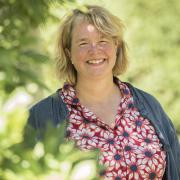


From Dorchester schoolgirl to Cambridge graduate, Imani Thompson’s debut novel Honey has become one of the most talked-about books of the year – a sharp, satirical tale about race, power and desire
When Imani Thompson was growing up in west Dorset, she already knew she wanted to study English at Cambridge and write novels, like Zadie Smith.
But when she made it all the way from Dorchester’s Thomas Hardye School to the hallowed university, she discovered English didn’t suit her. She switched to sociology and immediately found what she was looking for.
Imani’s debut novel Honey was born of this interest. How does society influence human behaviour? Can individuals shape society? Does the world act on us or do we act on the world?
Which is not to say that Honey is a dry academic tome – it’s the polar opposite: a compulsively readable tale of a young woman who decides the best way to deal with a sexist professor is to murder him, and having done it once, finds she has a taste for it. It’s a sharp, satirical story about race, power and desire.

Honey, published earlier this month, was described in Vogue as the ‘arrival of Britain’s brightest young novelist’. Even before she was published, Imani was much sought after. In the UK, 10 publishers competed in a bidding war for Honey, while nine did the same in America. It’s been sold to multiple overseas publishers and picked as a 2026 must-read by Esquire and The New Yorker
When I meet 27-year-old Imani at her family home in Piddlehinton, shortly before publication, she is in the calm before the storm and I am keen to understand how she became a writer.
‘I always loved scribbling stories and poems, and I was supported in that – first by parents and then by my English teachers at school,’ explains Imani, who grew up in the Westcountry with an English mother (Jess Morency, who writes for this magazine) and a father of Jamaican heritage, and has been writing from a young age. ‘I remember a teacher saying, “Oh, I read your story to the year above.” When you’re young, that’s a big deal. I feel so lucky for that.’
Alongside a supportive family, who read Honey in draft form and continue to champion her, Imani was deeply influenced by authors such as Malorie Blackman. Her award-winning YA book novel Noughts and Crosses, set in an alternate Britain, where black people are superior to white people, made her realise the power of fiction.
‘I remember sitting on the sofa with my mum while she read it to me. There’s a scene where the white character needs a plaster and there are only brown plasters available. And I was like, wow, so much of the world has just been explained to me. Because it was all of these feelings that I had around race or, you know, noticing being mixed race. That was a book that made me go “Oh, not only have I just understood the world but I’ve also understood what books can do, how they can give you a new understanding.” That was a huge moment.’
It was another writer of colour, Zadie Smith, who gave Imani the ambition to go to Cambridge, but when she got there, she found the academic study of literature sapped her creativity. Having taken two years out to travel and work abroad, she also had questions about the world that medieval poetry seemed unlikely to answer.

‘I actually had a big intellectual revelation a few months before I went to university, because Mum had just read Brit(ish) by Afua Hirsch and Natives: Race and Class in the Ruins of Empire by Akala and she gave them to me,’ explains Imani. ‘I read them when I was travelling and it was like that Malorie Blackman moment where I went, “Oh my god, that’s everything I’ve been thinking and feeling explained back to me.” Because at school, you don’t deal with Empire, you don’t deal with colonialism, you don’t deal with structural racism, but I had questions about all of these things.’
Imani says these writers gave her an intellectual frame for her feelings and when she switched to sociology, her studies encouraged her to consider not just what she was learning but the structure in which she was learning it.
‘You only ever write essays in response to questions, and you only get marked on those written answers,’ says Imani. ‘But at the same time, I was being taught about indigenous philosophies and thought practices that don’t require written work. I was learning about other ways of thinking, but there was no room at this university for that, because to pass my exams I had to write an essay.’
Inspired by what she was learning, Imani submitted ‘half a normal essay and half a non-normal essay’ as a deliberate challenge to the system – and left Cambridge with a First.
Her fictional protagonist Yrsa, a PhD student at Cambridge, has a similar interest in how to disrupt the status quo, but her actions take a darker turn. One of the most intriguing aspects of the novel is how much readers will believe that Yrsa’s theoretical ideas justify her murders or if they are just a convenient excuse.
Imani came up with the idea in her final year. ‘I was in D’Urbervilles café in Sherborne with Mum, talking about what I should write for my first novel. I wanted to write about all these feelings I had about being a woman in the world; things I was studying in terms of race; ideas about gender-based violence.
But that’s a hard pitch to a publisher! So I thought: “What if I wrote a book about a serial killer?”’ The serial killer genre was a ‘Trojan horse’ that gave Imani a reader-friendly way into exploring her themes, and by having a female serial killer she could ‘flip the lens’. But the book is more complex and ambiguous than a mere inversion of stereotypes.

Imani says researching serial killers led her into thinking about the ‘power trip of it, the sense of playing God’. Yrsa’s murderous activity, she says, ‘recreates all the things that she accuses her oppressor of’.
‘To me, that takes the book beyond race, beyond gender, beyond all these dynamics,’ Imani explains. ‘Ultimately, if you’re killing and killing and killing, it’s because you enjoy it.’
Imani finished a draft of Honey in a year while working as a bookseller at Daunts books in London, then found an agent, Nicola Chang, who helped edit the book before it was snapped up by Borough Press, home to big name authors like Rebecca Kuang and
Tracy Chevalier. Jo Thompson, editorial director at Borough Press, said: ‘I was utterly blown away by this debut novel and the questions it asks about identity, justice, the darker acts that occur in life and how we justify ourselves to ourselves.’
Imani is already at work on her second novel, and this one is set in Dorset, inspired by the Bibby Stockholm in Portland Harbour. As for her career beyond that, Imani says: ‘Ultimately, I’m just interested in the craft of writing, making myself as good a writer as possible.’.
Honey by Imani Thompson is published by Borough Press, priced £15.99