

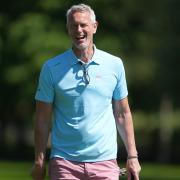
Five years after retiring from professional football, Anton Ferdinand has been preparing for his latest test; entertaining a new audience on ITV’s Dancing on Ice.
Regular television appearances as a sports pundit, working with the West Ham Academy and even 40th birthday plans, have had to take a back seat, as he trains to compete with the likes of Sir Steve Redgrave on skates.
But he is grateful the gruelling sessions are bringing routine to his new life, which sees him pulled in many directions.
Along with his brother, former England defender Rio, Anton is passionate about supporting grassroots football and projects in the local community.

'When my Mum passed away (in July 2017 aged 58, tragically two years after Rio’s late wife Rebecca), me and Rio sat either side of her in the Chapel of Rest. We were talking about our Mum and our Dad. Our Dad’s still here, but we were talking about their legacy.
'In Peckham my Mum, (Janice), was known for helping people along with my Dad, being people’s confidantes. The advice always came from a good place. We both just said, "how do we continue that legacy?" And it's to do something similar in the second part of our careers.
'I grew up in a community that was supportive within and outside my family. I am what my parents helped create so I think it’s important to give back to the community you live in. Essentially when your kids have to grow up in that community.'

'I’d spent a lot of time in Essex training in Rush Green every day for five years. So, it wasn’t a massive shock to me, it’s nice for me and the kids.
'My last club in England was Southend. Settling down in Essex made sense due to the sacrifice my wife Lucy had made moving up and down the country with me for 14 years.
'It’s also important for me to be able to give back to West Ham who gave me so much as a kid. A lot of the kids there are taking the path I took. I can help them in that I can give them little nuggets like I got from my brother.
'I’m not just helping young players, but West Ham can benefit too from potentially having another Declan Rice.'
Despite growing up in the city Anton is familiar with rural interests.
'Horse riding was keeping kids off the streets back when I was younger. When Rio made it as a footballer we could afford to go, but I started working at the stables to get lessons for free in Mottingham, south-east London. I used to work in the yard and then you’d get an hour on a horse.'
Outside of football, he is well known for being embroiled in a high-profile racism case back in 2011, after a complaint was made by a member of the public to authorities.
Former England captain John Terry was investigated by police and the FA for being caught on camera making a racist remark to Anton during a match between Queens Park Rangers and Chelsea.
Anton received a torrent of racial abuse online following Terry’s punishment by the FA, and criticism for not being vocal enough about prejudice. Making his powerful BBC documentary Anton Ferdinand: Football, Racism and Me, finally allowed that load on his shoulders to lift, when it first aired in November 2020.

Revisiting court documents and quizzing colleagues, unravelled exactly why such a public episode had impacted his career so severely, and how desperately he needed to deal with it.
'This horrendous incident happened to me and affected my life for so many years,' explains Anton movingly.
'Twitter had just taken off, and I was the first athlete to endure hundreds of thousands of racial slurs and tweets weekly.
'I now sit here, comfortable that it had to be me. I didn’t realise until I’d done it, but it became a therapeutic process to the point I was filming from nine until six, getting home, and going straight to bed, falling asleep before my head hit the pillow. That’s how much was coming off of me every day.'
As frustrating as the repercussions were for his career, Anton has a strong desire to help make change in the game and back other players who’ve felt lost or let down when abuse occurs.

'I never ever once thought the documentary would be a therapeutic process for me. Then I remember doing my last scene.
'I had to finish my talking, and walk past the camera down the pitch. I was looking in the sky thinking, "Mum, I done it. I done it Mum."
'It was inexplainable the feeling I had on that day. Because I never knew I was in that bad of a state and that’s the danger of mental health. Not knowing the state you’re in, as it’s a normal feeling.
'I always say I feel lucky to be here when I talk about mental health because a lot of people never get out of that state.'
Anton knows that appearing on Dancing on Ice will widen his fanbase and draw people’s attention to a case that many remain unaware of the correct details.

'Doing the documentary gave me my voice back and enabled me to speak freely. I’d been silenced for so long.
'After being approached by production companies for several years, Anton had to ensure his vision was respected.
'This was something that needed to be done right for me personally and at the beginning there was a meeting with the BBC.
'I said, "do you realise the importance of this documentary for me and my family, as I’m opening myself up again to the abuse I got before, but now I’ve got children. When it happened I didn’t have children, but not just that. After the incident I didn’t play in the Premier League again.
'So, if this isn’t portrayed the right way, and the way that I want it to, and if all of a sudden, I don’t work in football again, it wouldn’t be as bad, as I’d have done it my way.
'But if I do it your way and I don’t work in football again I’ll be kicking myself. So, it’s either going to be done my way or I’m not doing it." And fair play to the BBC they were receptive. They understood and we ended up creating something I’m really proud of.'
He feels that there is still much work to be done in terms of how seriously the football authorities treat racism and the pressing need to see action rather than words.
'There’s still a long way to go. People get eight months to a year ban for betting, but you only get four months for discrimination. Football bodies talk about racism as the number one thing they want to eradicate from sport, but you look at the actual punishment it tells you its low down on the list. The disparity is so deep.
'If you want to eradicate something you have to have a deterrent and I don’t think there’s a deterrent in football.
'I’m a believer that things happen for a reason. That was meant to be my journey. There’s always a positive that can come from a negative. And when you do find a positive, can you action it?'
As he embarks on this new chapter for 2025, Anton can confirm it’s his biggest ever physical challenge.

'I used to skate when I was younger in Streatham, in the six weeks holidays. That was just about getting on the ice and going as fast as you could before hitting the boards. DOI is all about control and elegance.
'Everything you’re meant to do as a footballer, skating goes against it. If the bottom half of your body is going one way the top half is going the other way to counter balance, so you stay strong if someone is trying to push you. On the ice, if you’re on the outside edge of your blades, your body has to go there as well.
'If you fall on the ice it’s like, "cut lets go again." In my sport you could make a mistake and someone else will cover up for you, and you don’t see. Mistakes on ice are there for everyone to see. What we have been asked to do, people can take five to six years to get to that level.'
The motivation for signing up is for his three children, and especially seven-year-old daughter, Lilah, who loves acting and dance.
'I wanted her to see her old man on the ice,' laughs Anton.
'It‘s so far out of my comfort zone, but that’s when you learn so much about yourself. When I did Don’t Look Down, (a highwire walk over the London Stadium on Channel 4), for Stand Up to Cancer, I learned so much.
'It also gives structure to my days. I am busy, but a lot of my business is sporadic, so it’s helping me as a person.'
There’s no doubt Anton’s three favourite cheerleaders; Flynn, 11, Lilah and three-year-old Farron, have the perfect role model in their father.
'Whatever they want to do, they’ll have the full support of me and Lucy. Would I want my kids to be footballers? Of course I would. If they didn’t do it, it’s not the be all and end all.'
Dancing on Ice is available to stream on ITVX







Share